
Philip Glass: Symphony no. 4 “Heroes”
Instrumentation: piccolo, 2 flutes, 2 oboes, 2 clarinets, bass clarinet, 2 bassoons, 3 horns, 3 trumpets, 2 tenor trombones, bass trombone, tuba, percussion, harp, piano, celeste, and strings
Approximate duration: 40 minutes
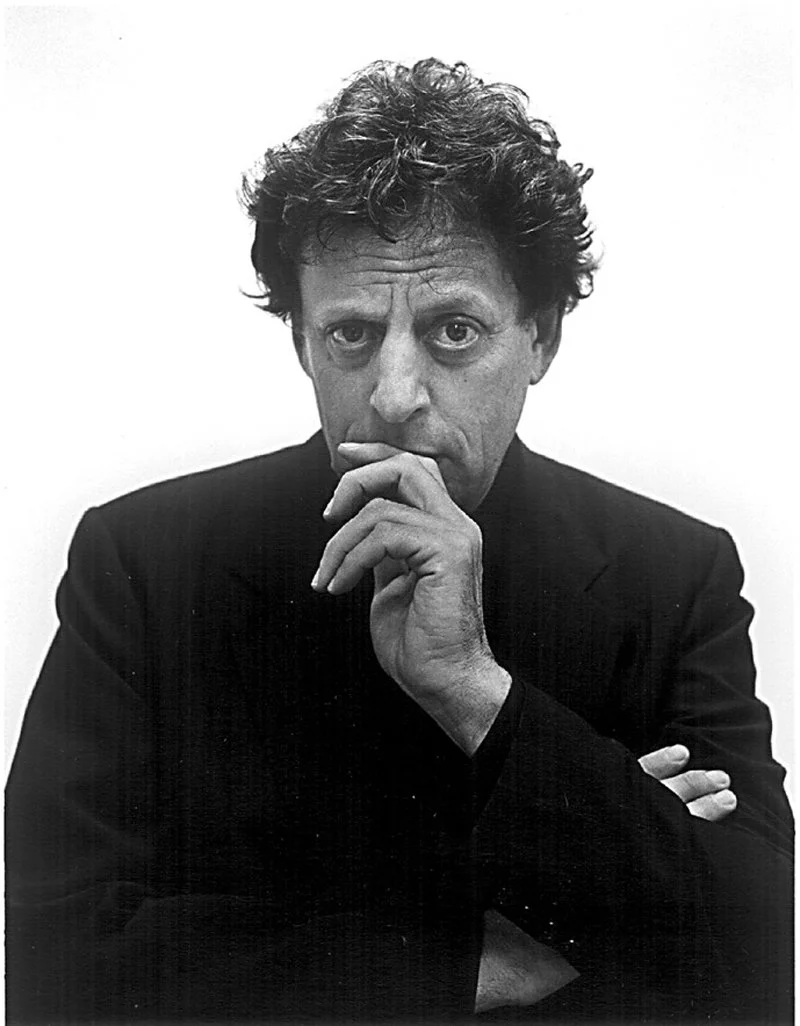
Quick: name an American composer who, while still relatively unknown to the classical music establishment, rented the Metropolitan Opera house to stage his own radically different four-hour opera, sold out the hall for both performances and in so doing permanently established international fame, but came out of the experience $90,000 in debt, so that, even as he was featured in international newspapers and magazines, he had to return to his earlier career – namely, driving a taxicab.
Yes, that’s correct: Philip Glass! Good job! OK – now, name another.
That really is the story of Philip Glass. The son of a Baltimore record store-owner, Glass studied flute as a child and entered the University of Chicago at age 16. He progressed from there to Juilliard and was building a solid career for himself, when at 26 he decided he needed a change of direction. He took himself to Paris where he studied with the legendary composition teacher Nadia Boulanger, whose students had included everyone from Aaron Copland way back in the 1920’s to Qunicy Jones, the jazz great who got rich as the producer and arranger of Michael Jackson’s “Thriller” LP. Boulanger took Glass back to the basics: “Solfege, counterpoint, and analysis, all day long,” as he put it later, with special emphasis on the music of J. S. Bach.
In Paris, he also came deeply under the influence of the Indian sitar master Ravi Shankar, best known in the West for introducing the Beatles’ George Harrison to the instrument. Glass was hired to transcribe Shankar’s traditional Indian ragas for Western instrumentalists, and in so doing was immersed into the complex world of Indian music theory. What fascinated Glass was that Western music historically approached time by dividing it into smaller and smaller units (a melody being divided into measures, in which whole notes are divided into half notes, half notes into quarters, and so on), but Indian music took the opposite approach: in it, small rhythmic cells are added together to create larger units, then those larger units are arranged in repetitive cycles to create still larger units of form.
He returned to the States determined to create his own, utterly new style of music: using simple tonal harmonies and clear textures, he would add together and repeat small melodic units, cycles of wheels within wheels, all unfolding very slowly and creating a hypnotic effect where small musical changes could feel very dramatic.
The 1975 opera Einstein on the Beach was Glass’s first large-scale exploration of these ideas, and – because an established opera company wouldn’t have even thought of presenting anything so weird – the composer was forced to become entrepreneurial, renting theatres and staging it himself. The aforementioned Met show was America’s introduction to it all, and the effect was seismic. Two of my professors were there, and they both reported that, while it was hard to see the stage from the balconies through the thick haze of marijuana smoke (seats throughout the theatre were still fitted with tiny ashtrays in those days), they were aware that something that would profoundly change the direction of American classical music was happening onstage.
Eventually the commissions that followed Einstein enabled Glass to quit the cabdriving business, and by the end of the 80’s he may have been America’s most in-demand composer. He has been as popular among experimental pop musicians as anybody, and the 1996 Symphony No. 4, Heroes, uses as its material music by his friends David Bowie and Brian Eno. Glass writes:
Heroes…is based on the work of Bowie and Eno. In a series of innovative recordings made in the late 70’s, David and Brian combined influences from world music, experimental avant-garde, and rock and roll and thereby redefined the future of popular music. The continuing influence of these wors has secured their stature as part of the new ‘classics’ of our time. Just as composers of the past have turned to music of their time to fashion new works, the work of Bowie and Eno became an inspiration and point of departure of symphonies of my own.”
Glass’ symphony is made of six sections, each more or less directly inspired by a track from Eno and Bowie’s 1977 album Heroes. Their material is seen through the trademark Glassian kaleidoscope of repeating melodic fragments and cascading arpeggios, and the lush, neo-Romantic orchestration that became a feature of his late 90’s music only adds to their immediate and visceral appeal.
- Chris Vaneman