
Duke Ellington: Black, Brown, and Beige
Instrumentation: 2 flutes/piccolo, 2 oboes, 2 clarinets, 2 bassoons, 2 horns, 2 trumpets, timpani & percussion, piano, and strings
Approximate duration: 25 minutes
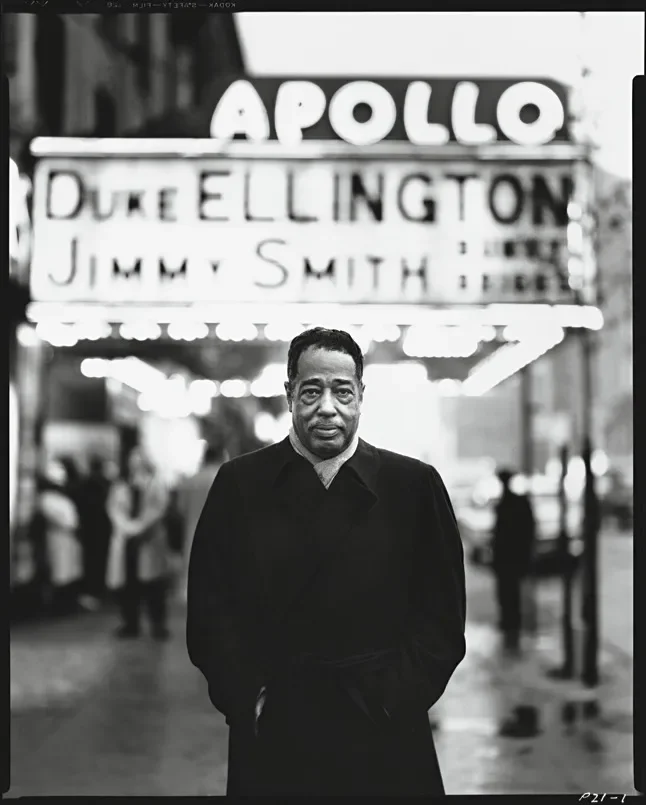
“There are simply two kinds of music: good music, and the other kind.”
Duke Ellington wrote this in 1963, and Ellington’s vast, five-decade career both testifies to and demonstrates that assertion. Ellington’s 20,000 performances, his output of 3,000 songs, pieces and arrangements – they all point to that one crucial fact.
Edward Ellingon’s maternal grandparents had been enslaved, but he grew up in middle-class stability in segregated Washington, D. C. On the family piano his father played the latest ragtime hits when his mother wasn’t playing operatic arias, and not long after beginning piano lessons at seven the boy was given the nickname “Duke” thanks to his precocious poise and dignity. He was playing professionally in less than a decade, and turned down collegiate scholarship offers in art to build his musical career.
By his mid-twenties he was a respected songwriter and bandleader as well as a pianist, and a five-year run as music director at Harlem’s fame Cotton Club made him one of America’s best-know musicians. By the time he left the Cotton Club in 1932 in order to tour Europe with his band, Ellington’s sophisticated arrangements and compositions had gone a long way to transforming jazz from a steamy vernacular music of illegal gin joints to the broadly respected art it is today. His innovations in orchestration and form, like his group’s virtuosity and polish, made jazz at home in the concert hall as well as the nightclub.
By 1943, Ellington had pushed onto the classical concert stage, and while he continued to write for and lead his big band, much of his creative energy in the next decades was devoted to blurring the distinction between “classical” and “jazz” – in effect, to recreate in the minds of the world the happy musical cohabitation of his parents as they shared the family piano. He and his band became the US State Department’s go-to goodwill ambassadors, performing thousands of concerts all over the world. During his life, he was awarded both the French Legion of Honor and the American Presidential Medal of Freedom; after his death in 1974, he was depicted on the face of a commemorative quarter and a USPS postage stamp.
Black, Brown, and Beige was in fact the very piece that represented Ellington’s leap onto the classical stage. Composed for a much-hyped 1943 concert at Carnegie Hall that numbered among its audience Eleanor Roosevelt, Frank Sinatra, Langston Hughes, Leopold Stokowski, Count Basie, and Marian Anderson, Black, Brown, and Beige is a three-movement piece that traces nothing less than the history of African Americans. Black, its first movement, begins by depicting the forced labor of the Africans brought to this country as slaves and ends with the gospel of a Sunday church service. Brown depicts the service of African-Americans in wars for their country, from the Revolutionary to WWII, and ends with a Blues that laments their continuing struggle for equality. Beige finally celebrates the cultural and economic progress as seen in the Harlem Renaissance of the 1920’s and 30’s.
“Beyond genre” was the phrase Ellington lived by, and it is embodied in the glorious paean to his people that is Black, Brown, and Beige.
- Chris Vaneman