
Leonard Bernstein: Chichester Psalms
Instrumentation: 3 trumpets, 3 trombones, timpani & percussion, 2 harps, strings, and SATB chorus
Approximate duration: 20 minutes
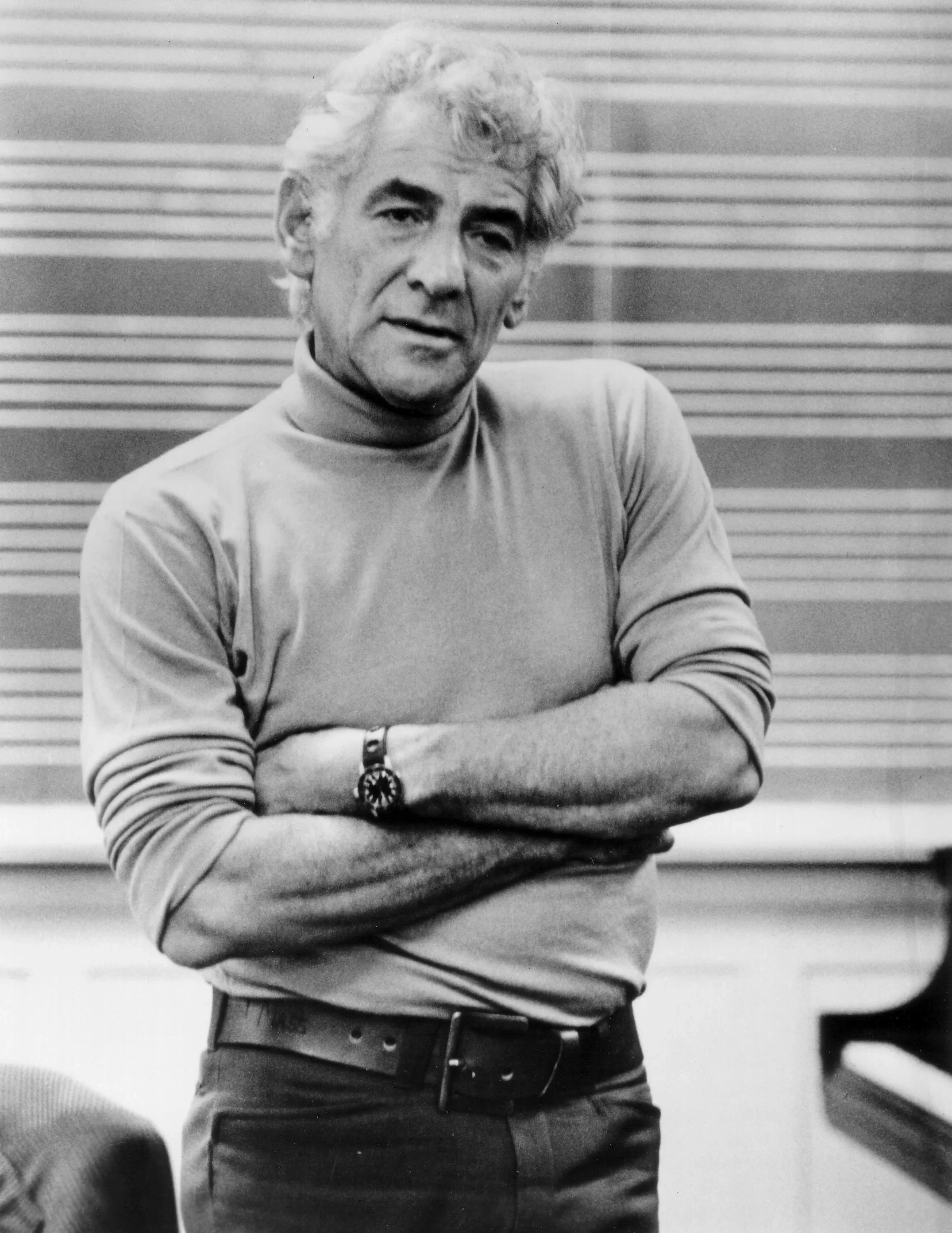
Leonard Bernstein was, without a doubt, the best-known classical musician America has ever produced. Respected worldwide as a conductor and composer, he was an out-and-out media celebrity in the 1960’s and 70, appearing regularly both on network TV and in the pages of supermarket tabloids. West Side Story, his 1957 musical retelling of the Romeo & Juliet story, was so culturally pervasive that, as a child in the early 1980’s, I wondered briefly if the federal government had simply issued copies of its soundtrack LP to all respondents of the 1970 census, since every grownup I knew had a copy in his or her record collection.
Bernstein burst into the spotlight as a young man when, in 1943, he substituted at the last minute for the ailing New York Philharmonic director Bruno Walter. Bernstein brought down the house and won the affection and admiration of the Philharmonic players, a thick-skinned lot of ever there was one, and he was the Philharmonic’s Music Director though most of the 1960’s (perhaps surprisingly, at the time he was the first American to lead one of our country’s top orchestras). He introduced the orchestra to millions of Americans on innumerable nationally-broadcast TV programs, and his animated, telegenic presence and earnest articulateness on matters cultural and political made him both an icon and an easy target for satire.
But it is as a composer that Bernstein is remembered best today. He wrote music for the concert stage and the theatre; his great compositional gift, and his overriding passion, was to unite America’s vigorous popular music traditions with “serious” classical music. Despite his three symphonies and his many wonderful concert works, he himself harbored “a deep suspicion that every work I write, for whatever medium, is really theatre music.”
And the Chichester Pslams, for all their worshipfulness, show more than a little theatre music in their DNA. They were commissioned in 1965 by Rev. Walter Hussey, Dean of Britain’s Chichester Cathedral and a man who would go on to become a close friend of the Bernstein family. Hussey was a big fan of the jazzy and Latin elements in West Side Story, and he urged the composer to incorporate as many such elements into the choral work as he could; thus we have a setting of Psalms from the Hebrew Bible that at times uses music adapted from the sketches for West Side Story and On the Town.
Bernstein’s playfulness didn’t stop there, though – he enjoyed inserting secret in-jokes with his children into his music, and I may as well apologize right now for letting you in on the fact that the first movement’s setting of Psalm 100 (“Make a joyful noise unto the Lord”) makes repeated reference to the awesomely catchy theme song of the TV show “The Flintstones.” Once you’ve heard it, you can’t un-hear it.
Each of the piece’s three movement features a setting of a full psalm (in the first movement the aforementioned Psalm 100, in the second the familiar Psalm 23 (“The Lord is my shepherd”), and in the third Psalm 131 (“Lord, Lord, my heart is not haughty”); each movement also includes, by way of commentary or contrast, a verse from another psalm. They progress, then, from simple joy, through anguish and consolation, to a heartfelt plea for peace and understanding. And they show the many sides of their composer: exuberantly and playfully theatrical, sincere in his Jewish faith, and a committed humanist. And, also, an appreciator of good cartoon theme songs.
- Chris Vaneman