
Chris Brubeck: Confluence
Instrumentation: 2 flutes, 2 oboes, 2 clarinets, 2 bassoons/contrabassoon, 4 horns, 3 trumpets, 2 tenor trombones, bass trombone, timpani & percussion, piano, electric bass, drum kit, and strings
Approximate duration: 25 minutes
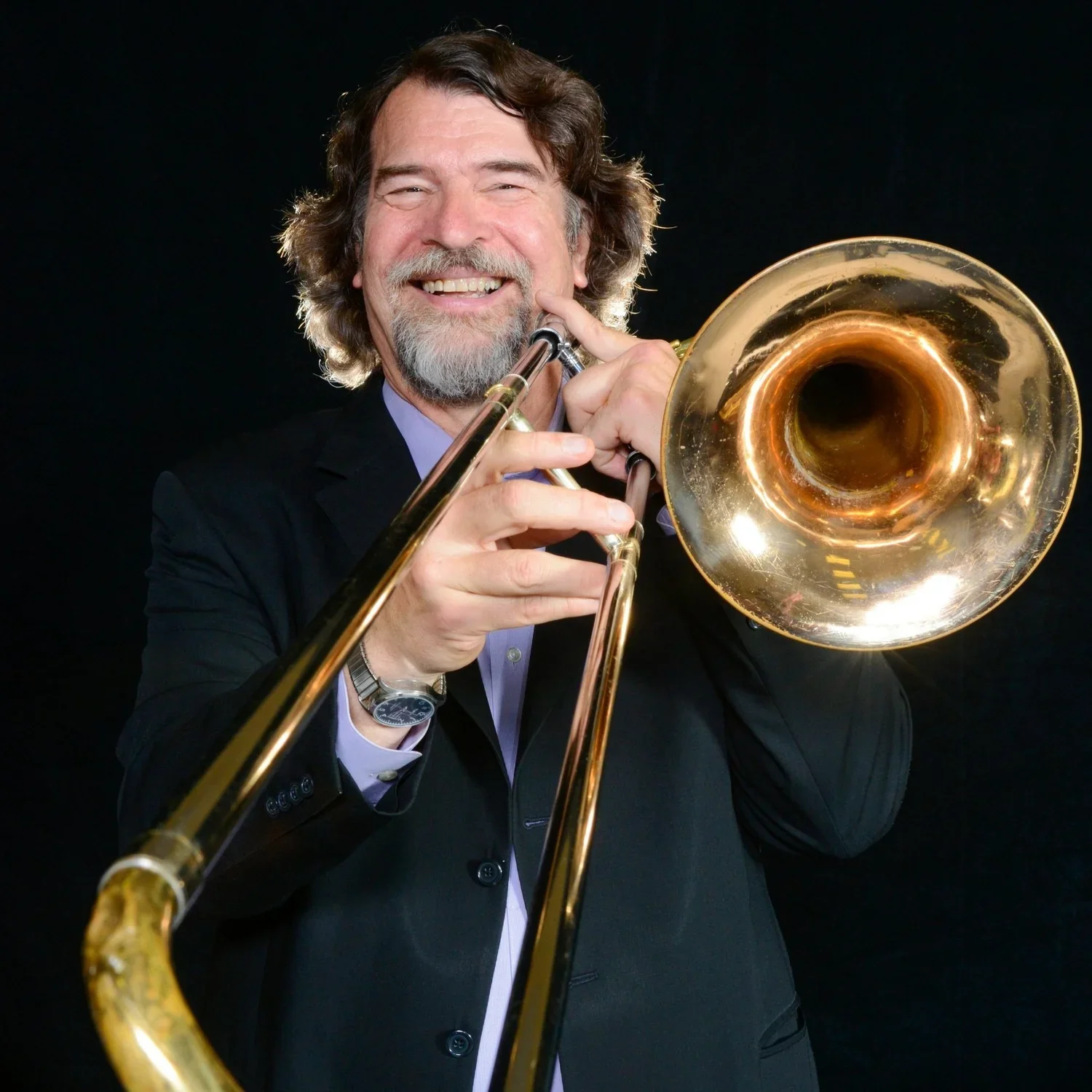
While composing the first movement of Confluence, entitled “Sunrise; Streams of Consciousness,” I had an image in mind... a lazy shaft of light glides through the trees and reflects off the still backwaters of the Mississippi. Bit by bit the current increases and the music starts flowing downstream, picking up tempo and attitude as it wanders towards a more “citified” destination. A rhythmic pulse is gradually introduced and the more Classical music styles and textures are left upstream as more urban and contemporary beats emerge.
I was encouraged by a member of the commissioning orchestra to insert into the musical parts and score a description of what I was feeling and envisioning. Some traditional Italian musical terms like “Misterioso,” and “Tranquillo” are written in the orchestral parts at the top of the peaceful introduction. But later on, completely nontraditional musical terms are inserted in the parts; descriptive phrases like “transitioning from a fancy nightclub to a funky neighborhood bar.” Not exactly a phrase coined by Verdi. The second movement, “Adagio in Blues” has this note written in all the parts: “Imagine a nightclub at 2 a.m., last call, and 2 soulful guitarists.” I know this terminology seems a bit odd but fortunately my compositions have resonated with audiences and performers even though they are, or perhaps because they are, stylistically eclectic. This piece is no exception. The concerto culminates in a fiery third movement where odd metered Funk (7/8) and Jazz, plus a demanding Classical guitar cadenza form a musical whirlpool with the Blues to reflect the title; “Cross Currents.”
When the premise of this new work was presented to me by Memphis Symphony conductor Robert Moody, he asked me to write a double guitar concerto for Classical guitar and Blues guitar. That request was asking for stylistic duality right off the bat. The contrast between these two styles is dramatic. Some sections of this piece could only be played by a masterful Classical guitarist. Other parts are written to feature a Blues master and are designed to turn the player loose, bringing all prior Blues knowledge into their improvisations. I come from a Jazz background, and I know there is nothing like the thrill (for the performer and the audience) of hearing a musical idea come to life for the first time right on the stage. In 1960 my father pioneered this kind of music (Classical balanced with Jazz, or written music integrated with spontaneous composition), with none other than Leonard Bernstein and the New York Philharmonic “backing” the Dave Brubeck Quartet at Carnegie Hall. So, I grew up knowing this so called “Third Stream” music was possible and powerful. Nowadays Third Stream has evolved into a mighty river of sound, Soul and Swing.
- Chris Brubeck