
Gershwin: An American in Paris
Instrumentation: 3 flutes/piccolo, 2 oboes, english horn, 2 clarinets, bass clarinet, 2 bassoons, soprano saxophone, alto saxophone, tenor saxophone, baritone saxophone, 4 horns, 3 trumpets, 2 tenor trombones, bass trombone, tuba, timpani & percussion, celeste, and strings
Approximate duration: 16 minutes
By the time Ellington premiered Black, Brown, and Beige at Carnegie Hall in 1943, that building had already come to stand for much of what it does now – not just the best in American classical music, but conservative, old-money, upper-class taste in all things cultural and musical. When it was built in 1891, however, Andrew Carnegie intended it to be a refuge from the upper class. Carnegie and his family, like other newly-rich industrial barons, were looked down upon as pushy arrivistes by the blue-blooded families who made up New York’s cultural aristocracy; accordingly, the Carnegies were made to feel unwelcome at the city’s concert halls, given the cold shoulder during intermissions and refused the most desirable seats. Finally growing tired of enduring such snobbery at concerts, Carnegie decided to just build his own concert hall, and it’s that very hall that had already come to seem so significant when Ellington took its stage in 1943.
All this to say that if patrons have ever been made to feel foolish or self-conscious at some other concert of classical music, well, you’re not the first. More, even, than Europeans, Americans have used classical music as a sort of class delineator, way of separating those of breeding and description from the great unwashed masses. Likewise, for much of the 20th Century many highbrows tried to keep Classical music “pure,” untainted by the corruption of Jazz and popular music. These decidedly elitist conceptions of the value and meaning of classical music still linger, but the best – and, not coincidentally, the most beloved – of American composers have always kicked back against them.
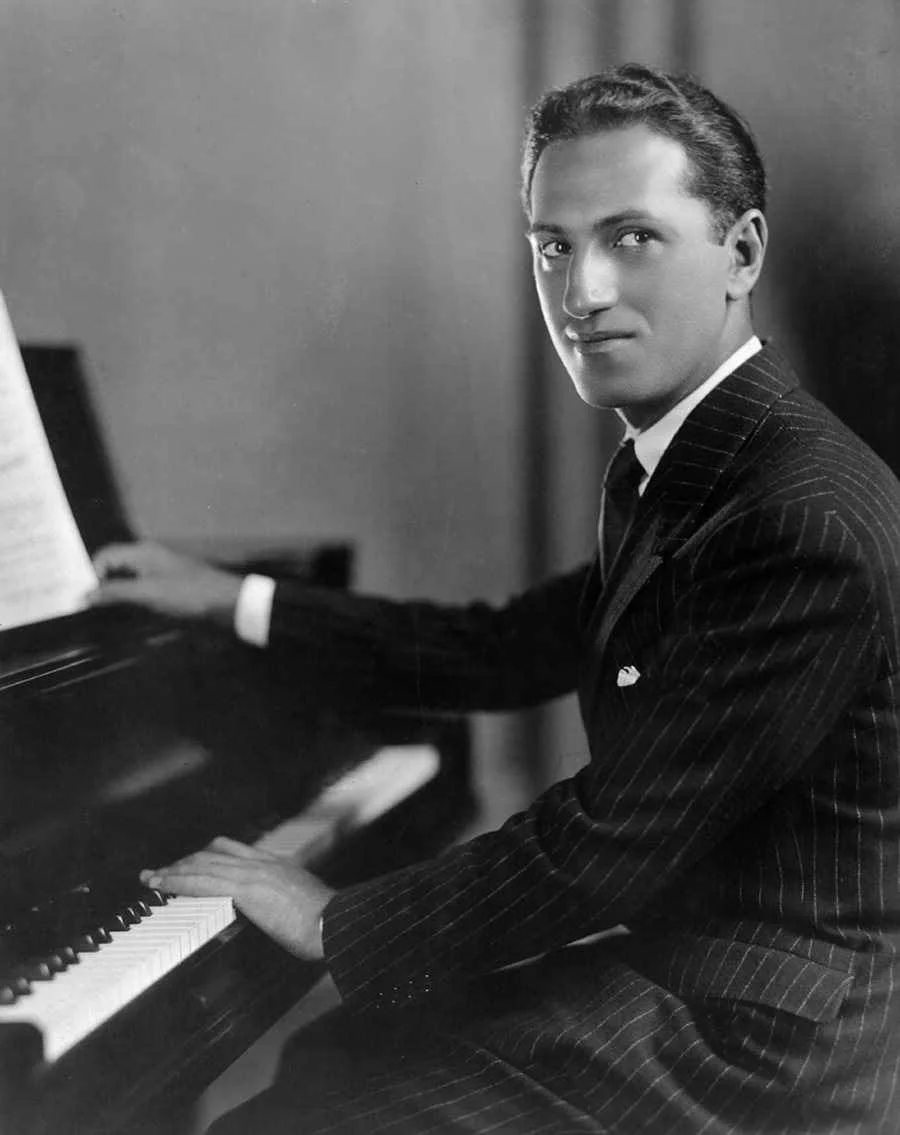
Exhibit A? George Gershwin. The younger son of Jewish immigrants from Eastern Europe, Gershwin began teaching himself piano around the age of seven, when his parents arranged for an upright instrument to be hoisted into a window of their apartment so his older brother Ira could study it. Ira was a more literary turn of mind, though, and was relieved when George hogged the instrument so continuously that Ira was permitted to stop his lessons.
By the age of 16 George had dropped out of school to begin working as a song plugger. “Song plugger” is a profession that, alas, the IRS no longer sees so much on its tax forms. A song plugger was a young pianist who offered continuous live demonstrations of newly-published sheet music for music store patrons; there were so many song pluggers working the music stores on 28th Street in New York that it became known as Tin Pan Alley, because with so many pianos playing popular songs all it once, it had the effect to passersby of hearing tin pans crashing together.
Gershwin sold his first song, for the princely sum of 50 cents, to a music publisher at age 16, had a ragtime hit at 17, and by 20 had written a Broadway musical that immediately spawned one the most popular songs in the country. But even as he wrote hit after hit in the world of popular music, Gershwin aspired to master the complex, longer forms of classical music. He sought out lessons from both Ravel and Stravinsky: both refused, with the former asking, “Why become a second-rate Ravel when you’re already a first-rate Gershwin?” and the latter, on hearing what Gershwin had earned in songwriting royalties the previous year, exclaiming, “You should be teaching me!”
While Ravel refused to teach Gershwin, he did become the American’s good friend, and it was Ravel’s hosting of the young American in 1926 that inspired An American in Paris. An American in Paris was the third of Gershwin’s successful forays onto the Classical concert stage, after the smash success of Rhapsody in Blue in 1924 and its followup Concerto in F a year later. An American in Paris was composed in 1928; as he wrote in Musical America, “An American in Paris is intended to portray the impression of an American visitor in Paris as he strolls about the city, listens to the various street noises, and absorbs the Parisian atmosphere.”
Gershwin’s dedication to capturing those street noises is immediate – he carried four Parisian taxicab horns back to New York to capture their distinctive sound in the piece’s premiere, and they make an appearance within seconds. A loosely structured symphonic poem, the work proceeds from each of its five sections to the next one on Gershwin’s unerring musical instincts. Audiences loved it immediately, and when Vicente Minelli used it in its entirety for Gene Kelly’s extended dance sequence in the 1951 Best Picture Oscar winner of the same name – well, in a sense, Gershwin’s vision was perfectly realized.
- Chris Vaneman