
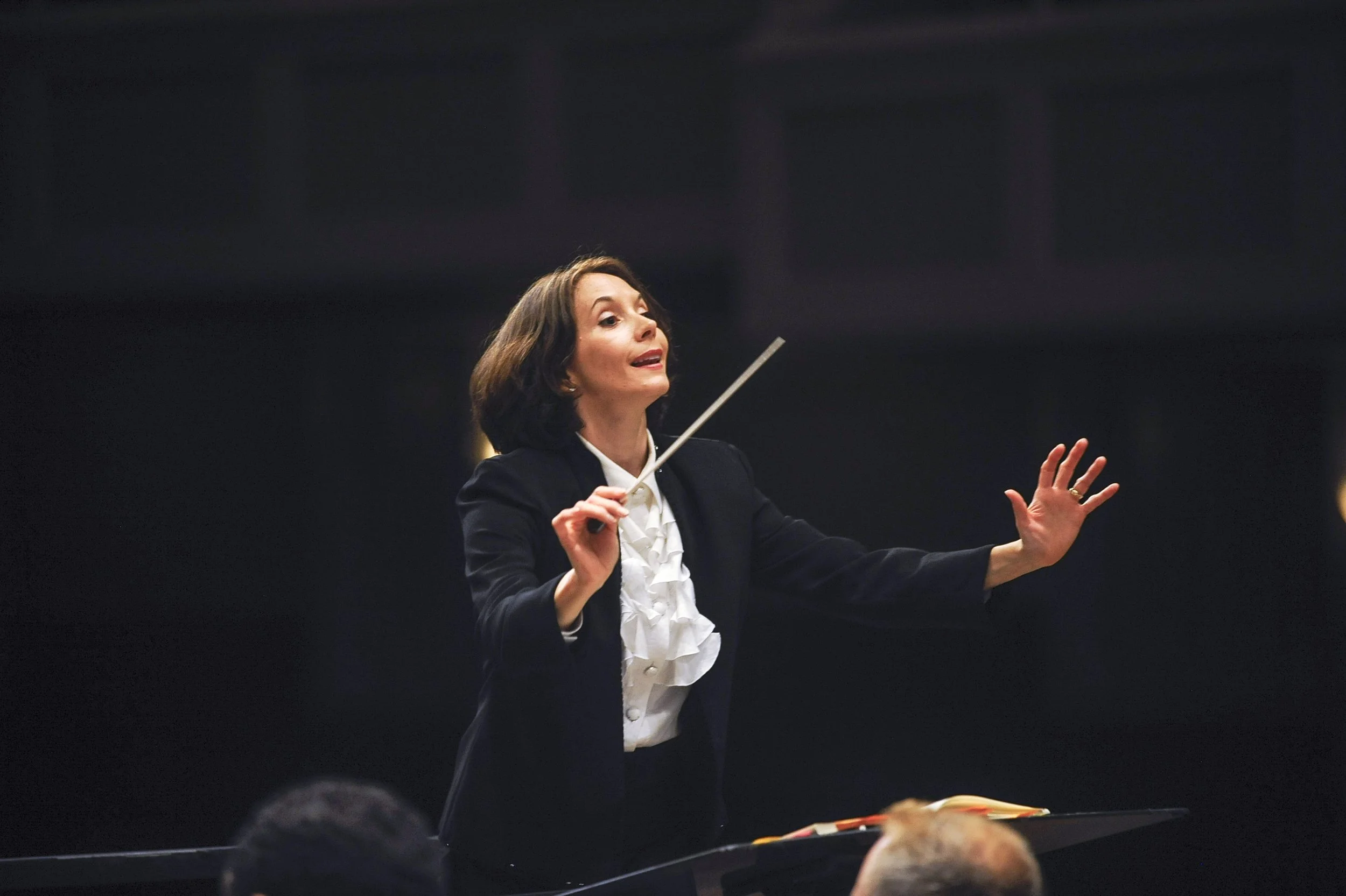
Sarah Ioannides conducting the Spartanburg Philharmonic
Conducting: A View from the Stage
Mark Britt
Principal Trombone
“Make sure your pants are pressed and your shoes are polished”! Sage advice I received from one of my conducting professors when I was in graduate school. It may seem peculiar to many of us, but the audience stares at a conductor’s backside the entire concert! The last thing an audience wants is to be distracted by wrinkled clothing and scruffy footwear:)
The musicians on stage have different vantage points from what the audience sees and experiences in any performance. Audiences see the hands guiding and shaping the sound, while the musicians watch the conductor’s eyes....looking for facial expressions, if you will, that tell us we are on the right path or have ventured astray. (We do watch the hands too, but most of us are loath to admit it!) Much of the information we need is relayed in posture and facial expressions. A reassuring glance, an expression of approval when a difficult passage goes well, a raised eyebrow to alert us of an upcoming entrance, or a set of eyes rolled back into the sockets when mistakes occur, are what keeps the train on the track! These critical interactions, most of which the audience never sees, allow the ensemble to thrive in a performance. Admittedly, some modern concert halls do allow audience members to sit behind the orchestra where they can have a direct view of the conductor. If you are not overly concerned with the sonic impact of being behind the sound, then those are the seats for you! There you can experience the constant exchange of real-time guidance and persuasion as the orchestra responds to the conductor.
It is interesting that both the audience and performers put their trust in the only musician on stage who makes no sound whatsoever during a performance. It is as if there is sign interpreter for people who can hear! The conductor’s gestures and body positioning do direct the audience to focus on a particular group of instruments.....alerting them to what may be the most important line being played at a given time. As a trombonist who plays one of the shiny, loud, things located at the back of the orchestra, I am used to being told my line is NOT the most important. Some years ago, I was fortunate in graduate school to play under the highly influential conductor, Robert Shaw. Later in my career I served as the Principal Trombonist in the final Robert Shaw Choral Institute. Before EACH work, Maestro Shaw would look directly at the trombones and give us “the hand”. It was a forward-facing palm intended to convince us to play as softly as possible.....we interpreted that as “play with a square attack!” For a conductor to show such reverence for our sound even before we had played a single note was edifying...as least that was our interpretation:)
Nonetheless, we must affirm the interaction players need from the conductor is not the same as what the audience observes. For us, the conductor must be a multi-tasker with enough personalities to make even Mr. Hyde turn green with envy! Conductors are expected to be a bus driver, a traffic cop, a cat herder, or even a hunter/gatherer when one of us gets lost or makes a confident entrance that is blatantly in the wrong place (not that it would ever happen in the Spartanburg Philharmonic!). As performers, what we crave from the conductor is inspiration, pacing, guidance, and a relentless insistence on musical mastery. We need a reassuring look when we are faced with a gnarly passage, or a reaffirming nod when we deftly navigate said gnarly passage. When those testy solo passages are delivered with aplomb, the observant audience member will notice the musicians seated closely around the soloist swoosh their feet on the stage floor or use their hand to tap a soft ovation on the side of their leg. This often-undetected support from both the conductor and the musician on stage is an essential component of the ensemble culture and often what keeps us encouraged for the next gnarly passage that is certain to come! Keep your eyes and ears open for the foot swooshes.....they go by quickly!
Audience members should note that as much as we need a conductor, there are times a conductor can get in our way! If you, as an audience member, see the conductor stop conducting....it does not mean he or she is lost.....they are essentially getting out of the way! Things on stage are going so well a conductor is not needed for the musicians to play the passage at hand. When the orchestra begins to gel in ways that often defy explanation... breathe as one, move as one, articulate as one, and sense the direction of the music as one.....it is a beautiful thing! The critical element when this happens is that the conductor relinquishes their grip on the steering wheel, finds a place in the figurative front seat to watch what is happening, and lets the orchestra “drive the bus”! These magical moments are what the performers live for. Knowing when to “let go of the steering wheel” is certainly more art than science for any conductor but it is one of the most admired attributes from the player’s perspective.
At other times the audience may observe a conductor motioning in what appears to be continuous circles. One of two things has happened....the orchestra is dragging the tempo, or the conductor is lost. The circles will stop when one of those two things is corrected! Likewise, audiences may observe the orchestra members bury their heads in the music stands and appear to not watch the conductor at all. That is undoubtedly a valid observation. If a passage is too difficult, too awkward, or too fast for the players to look up from the stand, we “dig in” and come up for the proverbial air when the passage is over. In some intricate passages certain patterns or gestures we see from the podium can distract us from successfully traversing a given phrase or musical passage. When those times occur, the players will affectionately scribble a “DLU!” (Don’t Look Up) on their part and the audience will see us raise our heads once the crisis has passed!
To be sure, performers do not focus on what the audience sees from their “rear-view mirror.” What the players see is a silent, benevolent, dictator who spends a week of rehearsals convincing us that their way is THE way! And we buy it! Once the conductor and orchestra earn each other’s respect, music making is the easy thing! That week-long exchange of ideas and negotiations is the performance an audience experiences each time they attend a Spartanburg Philharmonic concert. Performers do not even mind if a conductor’s concept of a passage is at odds with how we think it should be played. Our job as performers is to reflect the conductor’s vision, not ours, while bringing our own personalities and experience to the final product; that aural envelope of sound so deftly shaped by our silent partner with the shiny shoes!