
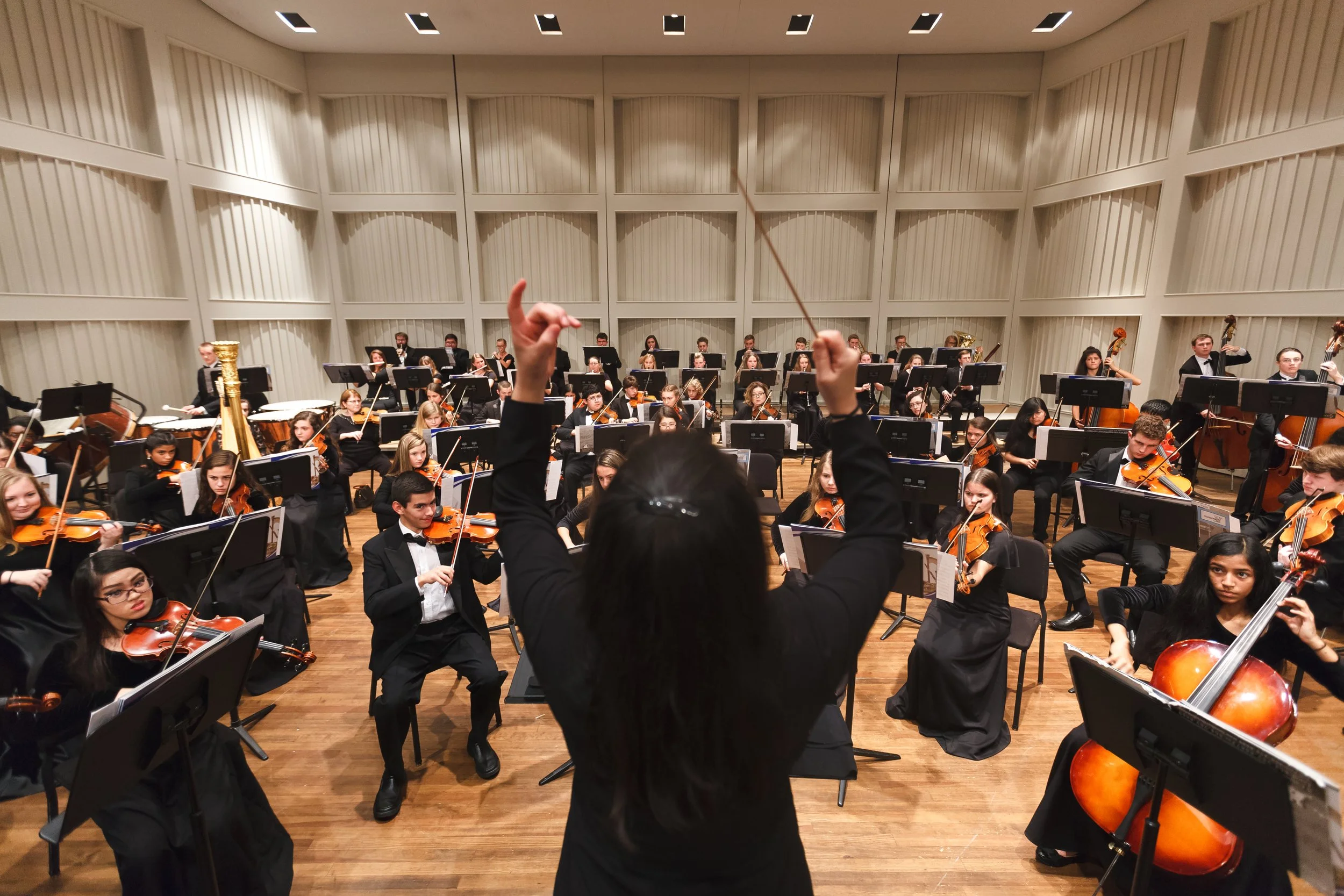
Dr. Susana Lalama conducting the Spartanburg Philharmonic Youth Orcehstra
Conducting: A View from the Podium
John Young Shik Concklin
Music Director
Early in my career, my teacher passed the definition of conducting to me, as it was to him from his teacher, and from his teacher before that. Conducting is the communication of musical ideas through silent gesture. Each time I revisit this phrase, I find it exceedingly elegant in its simplicity. It streamlines the mechanics of conducting, simultaneously leaving space for all the other things that we sense are happening, though are not easily determined.
Conducting is arithmetic in a sense. The physical gestures are the most efficient means of relaying information - tempo, pace, articulation, volume, feeling. X motion gets Y sound. Many of the fundamental movements have been developed and standardized over six centuries. I like to imagine that my physical language was spoken by Leonard Bernstein, Gustav Mahler, Felix Mendelssohn, and all the way back to Jean Baptiste Lully (the first documented conductor, who died from an injury sustained while conducting!). On the face of it, successful execution of these movements should lead to successful performances. Though if this were solely true, then every conductor would look the same and every performance would be equally compelling - which is certainly not the case. Additionally, if you were to ask ten different people about the one conductor, you’d walk away with fifteen different opinions.
Yet, when the conditions are right, there is an intangible essence to successful conducting that is not fixed. It is a bit mysterious and counterintuitive. However, there are moments in which conducting transforms from the physical and blossoms into a beautiful geometry. It is the place where 1+1 no longer equals 2; it becomes 3. It defies logic, yet is undeniably truthful. It can transport us from the physical to the liminal space on the edges of perception. It taps into something deeper. Though, as a conductor, I admit to you that conductors are only part of this miracle. The orchestra and audience are equally meaningful participants.
It’s a lifelong search for how this works. One of the greatest conductors, still alive today, puts it like this: there is sacredness in the shared and focused attention toward the singular goal that is a concert. If we take that to be true, which I do, then successful conducting relies on the gathering of people’s attention toward an idea: beauty, togetherness, grief, love, joy, or any feeling or feelings thereof. Everyone - staff, orchestra, audience - must be involved and engaged, not just the conductor. It is the conductor who commands this attention, who holds this conjured responsibility.
I’ve done enough to realize that successfully capturing this mercurial summit comes from alchemizing a combination of the musical and nonmusical: influence, technique, knowledge, persuasion, administration, management, emotional intelligence, charm, creativity, and communication, among others. Concert to concert, piece to piece, orchestra to orchestra, audience to audience - the combination changes. Immense treasure locked behind a fluctuating dial. There are few roles like it in this world and, perhaps for that reason, it is an intoxicating feeling when it all comes together.