
Ruta Allen is a proud member of the Thursday Study Club, founded in 1930. The Club’s constitution beautifully states that its purpose is “the pursuit of study as a means of general knowledge.” The group meets from October through May on the first Thursday of each month and currently includes 30 active members. Each year, the program chair selects a theme, and members volunteer to present papers inspired by that topic.
For the 2015–16 season, the chosen theme was The Symphony Orchestra. Ruta’s connection to the topic runs deep: She played cello with the Spartanburg Symphony Orchestra (now the Spartanburg Philharmonic) from 1979 to 1984. Music has always been part of her life — she grew up with a piano at home, took lessons through high school, and later rediscovered her love for music after moving to Spartanburg and studying cello with Hans Schmettau at Converse College.
Ruta, her husband, and their children moved to Spartanburg in 1976. They soon began attending Spartanburg Symphony performances and, over the past 50 years, she has enjoyed countless memorable programs under several gifted conductors.
Last fall, John Concklin and Katherine Poss welcomed Ruta Allen to the Piedmont Club for a drink. Over a lively and engaging conversation, Ruta mentioned she had written an article about conducting. John immediately expressed interest in reading it and suggested it might be a wonderful addition to a future edition of HearHere. That idea becomes reality as we share excerpts from Ruta’s reflections on conducting, paired with insights from two musicians in our own community — John Young Shik Concklin and Mark Britt.
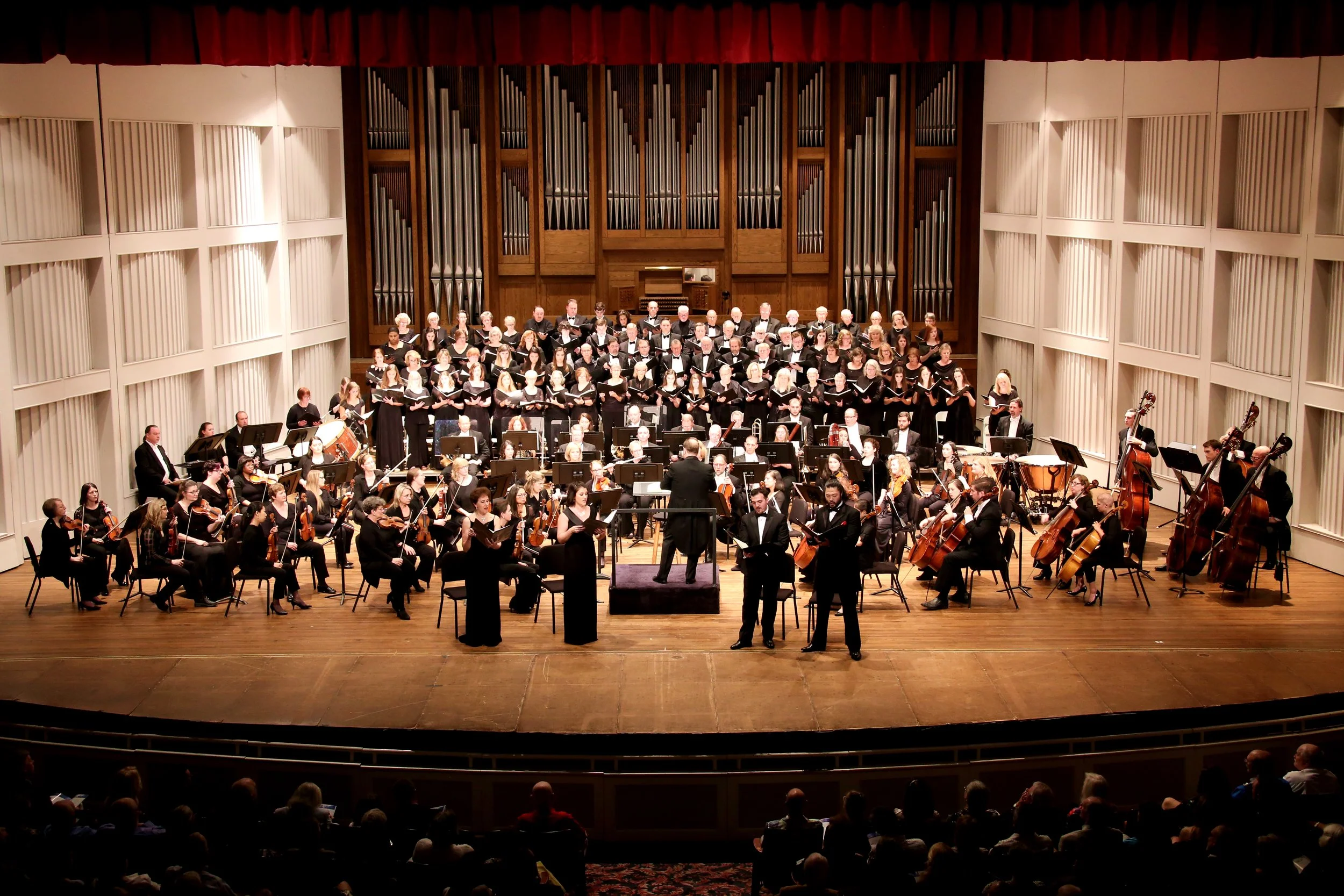
Stefan Sanders conducting the Spartanburg Philharmonic’s performance of Beethoven Symphony no. 9
Conducting: A View from the Audience
Excerpts from the Thursday Study Club
Ruta Allen
Contributing Author
A friend asked me, “Does a conductor really make a difference?” She said that unless she was listening to a major symphony versus a local one, the only thing she focused on was the piece of music. Was it pleasing to her? I think that is what most of us would say.
When I put the question to Miles Hoffman, he said, “not much, really.” We’ll see. My paper explores the history of conductors, their affect on orchestras, their interpretations of music, rehearsals, conductors’ techniques and the changes of conductors’ roles in modern orchestras.
Orchestras began to evolve in the last half of the 1600’s, the middle baroque period. Think about the music of Bach as an example. The earliest instrumental groups had no conductor. A violinist would usually lead ensembles with gestures and tapping sounds from their bow. Bach advocated leading instrumental ensembles from the keyboard, especially if the composer of the piece was a keyboardist. Mozart, who was prolific at the violin as well as the piano, when playing one of his concertos would “conduct” with his head.
The discussions of who would lead an ensemble began to coalesce around the principal violinist. Some violinists chose to roll up a score of music and use that to conduct rather than use their bow. A few adopted the baton before the end of the 1700s but many orchestras resisted it. Louis Spohr (1784-1859) claimed to have introduced the baton to the London Philharmonic when he was invited to be the guest leader in 1820.
Spohr (with very little modesty) writes in his autobiography, “My turn came to direct at one of the Philharmonic concerts, and I created no less a sensation than with my solo playing.” He goes on to describe that, during a rehearsal, he drew his conducting stick from his pocket and quite alarmed the orchestra with his novel approach.
I’ve already mentioned that most conductors also play a musical instrument at a high level. It develops physical coordination, discipline, a good ear, and the ability to create a performance. A knowledge of musical theory and musical history is also part of every conductor’s informational base. Harmony, counterpoint (sounds that are harmonically interdependent yet independent in rhythm. Again, think of Bach’s fugues), composition, orchestration, form and musical style. We probably underestimate how much a conductor has to study. When a conductor knows a piece so well that it is part of him, his heart, mind and hands feel inhabited by the music. That way a conductor can have almost constant eye contact with his musicians and guide them in his interpretation of the music.
Traditionally, the right hand holds the baton and keeps the beat. One of the main jobs of the conductor is to indicate the right tempo but the conductor is not “a metronome in a tuxedo.” Most good orchestras don’t need anyone to “keep time,” but the conductor also uses the baton to shape the sound quality of the various parts of the orchestra. The baton movements closely match the music’s character. Is it delicate or bold?
So, what are the mechanics of the podium dance performed by conductors? Concert goers listen to the music, but they watch the conductor. One conductor described it this way, “if you imagine trying to talk to someone in a totally foreign language, and you wanted to express something to that person without the use of language, how would you do that?”
What does the left hand do? One conductor describes it this way, “If the right hand sketches the outlines of the painting, the left fills in the colors and textures. The right hand creates the chocolate shell of a bonbon, and the left hand fashions the filling. It’s main practical use is to give cues to sections or individual players when to enter and when to cut off.” Some conductors will make jabbing motions, curl their hand, make a fist, give palm out or palm down. Far too many motions to explore.
It’s noted that professional players don’t need to be told when to come in, simple eye contact provides a cue. Some conductors say the eye should be the most telling in musical intent. Eye contact communicates not only when to play but how to play. To a sensitive musician it can communicate expression, style, and mood. This is another reason that conductors memorize music and fill pages with their own notations.
The program planning for the season is another job of a conductor as well as the artistic administrator. Planning a season involves many factors: chief conductors feel very strongly about the works they want to perform but the audience needs a “balanced diet” of music, a good mix of genres and style. Also, the musicians and their ability must be considered. An orchestra and all of its moving parts is, after all, a business.
Working regularly with the same orchestra is the ideal. In cities large and small, the community regards its conductor as an ambassador for its orchestra. The public wants to feel he belongs in their town rather than flying in the day before the performance and flying out the day after. Unfortunately, that can’t always be the case. Orchestras are largely dependent on private financial support, so a conductor needs to be involved in the fund raising process. When people donate, they are buying into an organization and will support it with their attendance. To further enhance the feeling of “we’re all in this together”, the conductor and musicians ideally should have some occasional contact with their supporters. Radio interviews, media coverage, school performances are all part of the orchestra’s success with attendance. Developing a cordial and good working relationship with the management and board is vital. It is better if everyone works in harmony.